
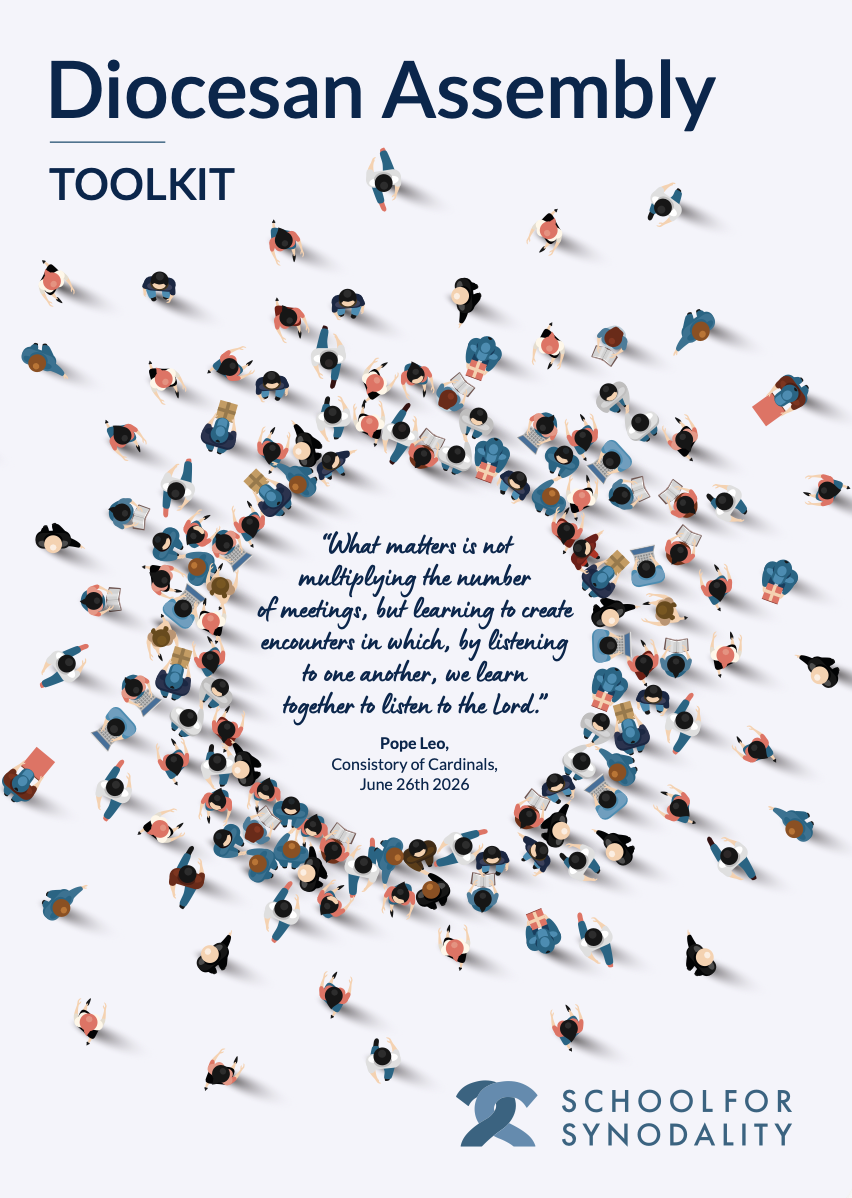
Diocesan Assembly Toolkit
Resource: The Diocesan Assembly Toolkit is a practical, prayerful guide to help synodal co-leads and teams prepare their diocese's Ecclesial Assembly, structured around the four steps of the journey: Prepare, Listen, Discern and Act.
Final Document Lent Reflections Series
Our Resource: Be ‘called to the journey’ to reflect each week during Lent on key passages of the Final Synod Document
On a journey through the wilderness of Lent, we invite you to join us as part of the School for Synodality in taking time to dwell on what it means to journey together and open ourselves to hear the whispers of God along the way.
We offer some spiritual reflection through material drawn from our resource, A Feast for All Peoples. Each week of Lent, we offer a piece of scripture, brief notes, a passage from the Final Document, and a reflective question to ponder.
We invite you to accompany us, praying for the grace to continue on the synodal path, whether in small steps or great leaps, always together.
We hope you will be encouraged to pray through to Week 7, when the journey concludes on Easter Monday. There, in the joy of the Resurrection, we will share the banquet prepared by Jesus on the lakeshore for his disciples.
Start the Journey here…
What to expect:
What is a self guided reflection?
Taking time to be still and reflect on your own terms in your own way using the reflection prompts. This is entirely for your own growth and spiritual nourishment, but with the knowledge that others all round the world will be reflecting on the same passages.
How to use this reflection series?
This can be used wherever you are, in your own time and in whatever context you are in. You may wish to start with your own short prayer such as the Our Father or Come, Holy Spirit. We suggest you take time to read each section (perhaps more than once) slowly and with intention. Be aware of your inner responses, as the Holy Spirit may speak to you in those quiet moments. You may wish to return to the series during the week as you ponder the reflection question.
Do I need to know about synodality or the Final Synod Document?
You do not need to know about synodality or the Final Synod Document to engage with this reflection series. Synodality is primarily a spiritual disposition, and this series is one opportunity to answer this call. For more about synodality we suggest you explore our Getting Started and FAQ pages.
The School for Synodality has also put together a helpful guide to the Final Synod Document which includes our Book Club that takes it chapter by chapter with expert speakers, Lectio Divina for certain passages and our small group resource A Feast for All Peoples upon which this reflection series is based.
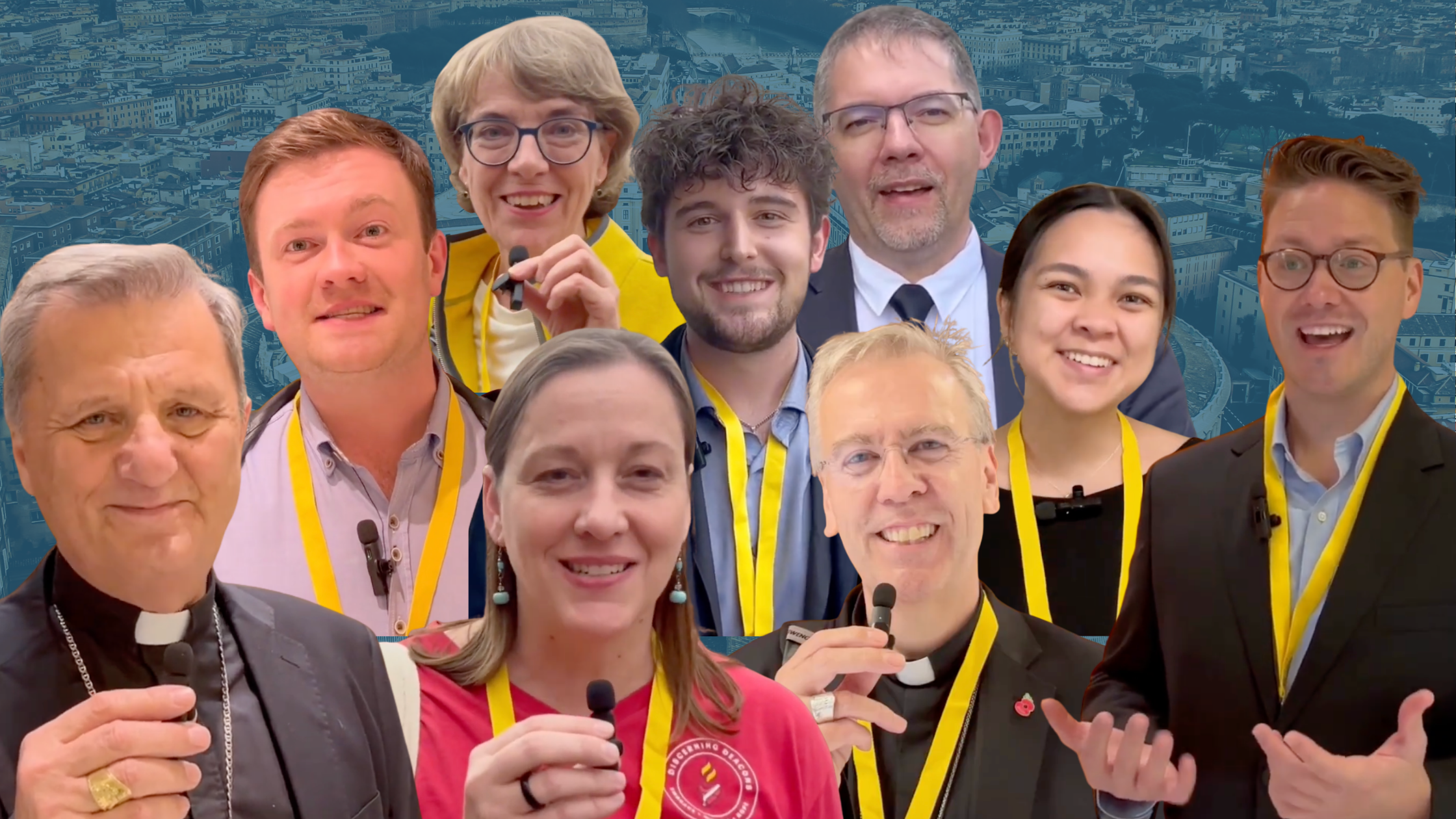
Testimonies - What Does Synodality Mean for You?
Our Resource: People from the Jubilee of Synodal Teams share what synodality means to them - showcasing a rich diversity of approaches that ultimately leads us to closer communion with Christ, and one another.

Reading the Final Document: Lectio Divina resources
Our Resource: Follow along as we reflect together on key passages from the Final Document from the XVI Assembly

The last stage of the three year Synod journey was the creation of a Final Synod Document called ‘For a Synodal Church, Communion, Participation and Mission'.
The Final Synod Document a rich resource, beautiful but rather technical in places. Much like we might do with scripture, its possible to reflect on individual passages of the Final Document and allowing them to inspire us. These reflections are an opportunity to reflect and respond alone or in groups, and we will be updating this page as we go along.
-
Our first reflection concentrates on the definition of synodality. This passage from the Final Document is taken from 'Part I: The Heart of Synodality' which looks at how we are called by the Holy Spirit to conversion.
“Oriented towards mission, synodality involves gathering at all levels of the Church for mutual listening, dialogue and community discernment. It also involves reaching consensus as an expression of Christ rendering himself present... In simple and concise terms, synodality is a path of spiritual renewal and structural reform that enables the Church to be more participatory and missionary so that it can walk with every man and woman, radiating the light of Christ”
- §28, Final Document
Questions for reflection:
What stands out for you from this passage? Is there a particular word or phrase that is resonating in you?
What are the possibilities for linking "spiritual renewal and structural reform"?
What possibilities does it open up for you?
-
“Synodality is primarily a spiritual disposition. A synodal spirituality flows from the action of the Holy Spirit and requires listening to the Word of God, contemplation, silence and conversion of heart... A spirituality of synodality also requires asceticism, humility, patience and a willingness to forgive and be forgiven. No one can progress along the path of authentic spirituality alone; we need support, including formation and spiritual accompaniment, both as individuals and as a community.”
- §43, Final DocumentQuestions for reflection:
What does it mean to think about synodality as 'primarily a spiritual disposition'? What changes does this require for our Catholic life together?
In a world that rewards loud voices and polarising opinions, how practically can we cultivate 'humility, patience and a willingness to forgive and be forgiven'?
The passage states the need for formation and community. Who might my companions be on this synodal journey (they might not be the obvious people)?
-
“We encounter three disciples on Easter Morning: Mary Magdalene, Simon Peter, and the disciple whom Jesus loved. Each of them is seeking the Lord in his or her own way; each has his or her own part to play in enabling the light of hope to dawn. Mary Magdalene is so driven by love that she is the first at the tomb. Alerted by her, Peter and the Beloved Disciple make their way to the tomb. The Beloved Disciple races to the tomb with all the strength of youth. He looks intently; he is the first to understand, yet he lets Peter go first, he who is the elder, entrusted with the responsibility of leading. Peter, weighed down by his renunciation of the Lord, has an appointment with mercy, the mercy which he will minister in the Church. Mary remains in the garden. She hears herself called by name. She recognises the Lord. He commissions her to proclaim his Resurrection to the community of disciples. For this reason, the Church recognises her as Apostle of the Apostles. Their dependence on one another embodies the heart of synodality.
The Church exists to bear witness in the world to the most decisive moment in history: the Resurrection of Jesus. … The Gospels tell us that in order to enter into Easter faith and become witnesses to it, it is necessary to acknowledge our own inner emptiness, the darkness of fear, doubt and sin. Yet those who, in the midst of darkness, find the courage to set out as searchers discover that they themselves are the ones being sought. They are being called by name, offered forgiveness, and, in turn, sent out to their brothers and sisters together.”
- §13 & 14, Final Document
Questions for Reflection:
This is a particularly rich passage. Which word or phrase stands out most for you?
Which of the three disciples do you most identify with? What does this phrase mean to you: "Their dependence on one another embodies the heart of synodality."
These two paragraphs underline the missionary quality of synodality: "The Church exists to bear witness..." How could synodality help your local community to become more outward looking?
-
“Ecclesial discernment is not an organisational technique but rather a spiritual practice grounded in a living faith. It calls for interior freedom, humility, prayer, mutual trust, an openness to the new and a surrender to the will of God. It is never just a setting out of one’s own personal or group point of view or a summing up of differing individual opinions. Each person, speaking according to their conscience, is called to open themselves to the others who share according to their conscience. In this sharing, they seek to recognise together “what the Spirit is saying to the Churches” (Rev 2:7). As ecclesial discernment entails the contribution of everyone, it is both the condition and a privileged expression of synodality, in which communion, mission and participation are lived. The more everyone is heard, the richer the discernment. Therefore, it is essential that we promote the broadest participation possible in the discernment process, particularly involving those who are at the margins of the Christian community and society.”
- §82, Final Document
This section of the document is particularly rich and practical in its description of discernment processes, including in 83, the place of Scripture, and in 84, laying out step by step how such processes can be best conducted.
These passages are worthy of close study for anyone involved in pastoral councils, finance committees, school governors, clerical consultation bodies or indeed any group seeking to discern God's will.
Questions for Reflection:
In the Pentecost light of the Church, how do you respond to the first sentence: "Ecclesial discernment is not an organisational technique but rather a spiritual practice grounded in a living faith"? How does this change how we think about decision-making in the Church?
What work is needed for people to develop "interior freedom, humility, prayer, mutual trust, an openness to the new and a surrender to the will of God"? How can we support this at different levels?
"It is essential that we promote the broadest participation possible in the discernment process, particularly involving those who are at the margins of the Christian community and society."
This is challenging. In week 3 of our online bookclub, Manila-based theologian Estela Padilla describes how one diocese in the Philippines paid a day's wages to manual labourers so that they could take part in discernment processes. What do we need to do in our context to engage all the voices?
-
“Each Baptised person responds to missionary needs in the contexts in which they live and work, according to their dispositions and abilities. This demonstrates the freedom of the Spirit in bestowing God’s gifts. Owing to this dynamism in the Spirit, the People of God, listening to the reality in which they live, discover new forms of commitment and new ways to fulfil their mission. Christians, each according to their diverse roles - within the family and other states of life; in the workplace and in their professions; engaged civilly, politically, socially or ecologically; in the development of a culture inspired by the Gospel, including the evangelisation of the digital environment - walk the paths of the world and proclaim the Gospel where they live, sustained by the gifts of the Spirit.”
- §58, Final Document
Questions for reflection:
What are the missionary needs in the contexts that you live and work?
What possibilities are there for 'new ways' to fulfil your mission?
Do you think of yourself as engaging 'civilly, politically, socially or ecologically...including the evangelisation of the digital environment'? What would you need in order to take up your mission in this way?
-
“Practised with humility, the synodal style enables the Church to be a prophetic voice in today’s world. “A synodal Church is like a standard lifted up among the nations (cf. Is 11:12)” (Francis, Address for the Commemoration of the 50th Anniversary of the Institution of the Synod of Bishops, 17 October 2015). We live in an age marked by ever-increasing inequalities; growing disillusionment with traditional models of governance, disenchantment with the functioning of democracy, increasing autocratic and dictatorial tendencies and the predominance of the market model without regard for the vulnerability of people and of creation. The temptation can be to resolve conflicts by force rather than by dialogue. Authentic practices of synodality enable Christians to be a critical and prophetic voice over against the prevailing culture. In this way, we can offer a distinctive contribution to the search for answers to many challenges faced by our contemporary societies in building the common good.”
- §47, Final Document
Questions for reflection:
At a time when our public discourse is ever more divided, what possibilities do you see for a synodal Church to be ‘a prophetic voice in today’s world’?
How do the synodal practices of listening, courageous speaking and discernment stand against inequalities, disillusionment and the use of force?
What might be our ‘distinctive contribution’ to the many challenges facing our world right now?
-
“God’s heart has a special place for the poor” (EG 197), the marginalised and the excluded. Therefore, they are at the heart of the Church. The whole Christian community is called to recognise in those made poor the face and flesh of Christ, who, though He was rich, became poor for us so that we might become rich through His poverty (cf. 2 Cor 8: 9). The preferential option for the poor is implicit in Christological faith. The direct knowledge of the suffering Christ (cf. EG 198) possessed by those who are poor makes them heralds of salvation received as a gift and witnesses to the joy of the Gospel. The Church is called to be poor with those who are poor, who often constitute the majority of the faithful, to listen to them, learning together how to recognise the charisms they receive from the Spirit. The Church also needs to learn to recognise them as agents of evangelisation.”
- §19, Final Document
Questions for reflection:
This is such a rich and radical passage, it might be helpful to spend more time than usual sitting with the text, asking the Holy Spirit to inspire you.It feels very counter-cultural to say that the poor ‘are at the heart of the Church’ – rather than, for example, the object of our pity or charity. What would have to change so that the poor, marginalised and excluded are at the centre of our Catholic communities, and not on the peripheries?
How are we ‘called to be poor with those who are poor’? What kinds of poverty are there in our local community?
What word or phrase are you taking away from this passage, to illuminate the rest of your day?
For a real-world expression of Church that is oriented to those on the margins, see Avril’s conversation with Estela Padilla, Filipina Theologian and Community Organiser, exploring chapter 3 of the Final Document on the conversion of processes, here » -
“What emerged throughout the entire synodal journey, and in every place and context, was the call for a Church with a greater capacity to nurture relationships: with the Lord, between men and women, in the family, in the local community, among social groups and religions, with all of creation. Many participants were delighted and surprised to be asked to share their thoughts and to be given the opportunity to have their voices heard in the community. Others continued to express the pain of feeling excluded or judged because of their marital status, identity or sexuality…
To be a synodal Church, we are required to open ourselves to a genuine relational conversion that redirects each person’s priorities, and we must once again learn from the Gospel that attending to relationships is not merely a strategy or a tool for greater organisational effectiveness. Relationships and bonds are the means by which God the Father has revealed Himself in Jesus and the Spirit. When our relationships, even in their fragility, allow the grace of Christ, the love of the Father, and the communion of the Spirit to shine through, we confess with our lives our faith in God the Trinity.”
- §50, Final Document
Questions for Reflection:To what extent do we prioritise relationships in our communities? What gets in the way of this?
What would it mean to "open ourselves to a genuine relational conversion that redirects each person’s priorities”? What would need to change for this to happen?
How do we understand ourselves as in relationship with the Father, Son and Holy Spirit? What becomes richer and deeper about our faith as we experience this more?
-
“The experience of rootedness means grappling with profound socio-cultural changes that are transforming the understanding of place. ‘Place’ can no longer be conceived in purely geographical and spatial terms but evokes, in our time, one’s belonging to a network of relationships and to a culture whose territorial roots are more dynamic and flexible than ever before. Urbanisation is one of the main factors driving this change. Today, for the first time in human history, most of the global population lives in cities. Large cities are often urban masses without a history and identity in which people live an isolated existence. Traditional territorial bonds are being redefined, blurring the borders of dioceses and parishes.
Living in such contexts, the Church is called to rebuild community life, to put a face to faceless entities and to strengthen relationships in this milieu. To this end, we must not only continue to value still- useful structures; we also need “missionary creativity” to explore new forms of pastoral action and identify concrete processes of care. It remains the case that rural contexts, some of which constitute genuine existential peripheries, must not be neglected and require specific pastoral attention, as do places of marginalisation and exclusion”
- §111, Final Document
Questions for Reflection:This passage is quite dense, which makes it perfect for a Lectio reflection! Take some time to mull it over, perhaps reflecting particularly:
In what ways do I experience change, both in the world and in my local Catholic community?
The passage describes urbanisation as a significant driver of change, which can lead to isolation. How can Catholic communities be places of gathering and relationship?
What possibilities for “missionary creativity” do you see in your local context?
-
“We should, therefore, look to the Gospels to outline for us the journey of conversion we are required to undertake, learning little by little to make Jesus' practices our own. The Gospels present to us a Lord who is often “in the act of listening to the people who come to Him along the roads of the Holy Land” (DCS 11). Jesus never sent anyone away without stopping to listen and to speak to them, whether men or women, Jews or pagans, doctors of the law or publicans, righteous men and women or sinners, beggars, the blind, lepers or the sick. By meeting people wherever their history and personal freedom had led them, He revealed to them the face of the Father. By listening to the needs and to the faith of those He met, and by responding through words and gestures, He renewed their lives, opening the path to healed relationships. Jesus is the Messiah who “even makes the deaf to hear and the mute to speak” (Mk 7: 37). He asks us, His disciples, to do the same and, through the grace of the Holy Spirit, gives us the capacity to do it conforming our hearts to His... When we listen to our sisters and brothers, we are participants in the way that God in Jesus Christ comes to meet each of us.”
- §51, Final Document
Questions for Reflection:This passage presents listening as a deeply radical act, leading to conversion. When in your own life have you experienced listening in this way?
Jesus listened to everyone he encountered, whether religious leaders or beggars. What opportunities do you have to listen to new voices?
Throughout Lent, can you challenge yourself to slow down each day and offer someone the gift of being truly listened to?
-
“Gathered from every tribe, language, people and nation and living in different contexts and cultures, the synodal process gave us “the spiritual taste” of what it means to be the People of God... Within the plurality of contexts where the local Churches are rooted, the People of God proclaim and bear witness to the Good News of salvation. Being in the world and for the world, they walk together with all the peoples of the earth, in dialogue with their religions and their cultures, recognising in them the seeds of the Word, journeying towards the Kingdom. Incorporated into the People of God by faith and Baptism, we are sustained and accompanied by the Virgin Mary, “a sign of sure hope and comfort” by the Apostles, by those who bore witness to their faith to the point of giving their lives, and by the saints of every time and place.”
- §17, Final Document
Questions for Reflection:As we come to the final stages of the Easter season, approaching Pentecost and the birthday of the Church, we reflect this month on our purpose and calling. To put it bluntly, what are we for?
What is the context of your local Catholic community (urban, suburban, rural, etc?). Who are your neighbours and how do we accompany them?
What does it mean to you to be “in the world and for the world”? How is this lived out as part of our witness and calling?
As we await the great feast of Pentecost, in the company of the Virgin Mary and the Apostles, what is your prayer to the Holy Spirit for the Church?
-
“The identity of the People of God flows from Baptism in the name of the Father and of the Son and of the Holy Spirit. This identity is lived out as a call to holiness and a sending out in mission, inviting all peoples to accept the gift of salvation (cf. Mt 28:18-19). The missionary synodal Church springs from Baptism, in which Christ clothes us with Himself (cf. Gal 3:27) and enables us to be reborn of the Spirit (cf. Jn 3:5-6) as children of God. The whole of Christian existence has its source and horizon in the mystery of the Trinity, which brings forth in us the dynamism of faith, hope and love.”
- §15, Final Document
Questions for Reflection:
We don’t reflect very often on our baptism as the source of our identity. What does it mean to you to be a baptised Catholic?
Although baptism is a gift to each of us individually, it makes us part of the People of God. How do we know ourselves as part of that global community of faith, ‘called to holiness and a sending out in mission’?
Spend a moment giving thanks for those who brought you to be baptised, and who have been important in your faith journey.
-
Check back here soon for the next reflection

A Feast for All Peoples - Small Group Resources
Our Resource: A Feast for All Peoples our new small group resource is aimed to support groups in exploring pathways to synodality through scripture, the Final Document and Conversations in the Spirit.

Book Club - Reading the Final Synod Document
Our Resource: The School for Synodality’s Book Club explores key aspects of the Final Document with key guest speakers, taking us through chapter by chapter.
‘Reading the Final Synod Document Together’-
the School for Synodality’s Online Book Club
After four weeks of listening, discerning and writing in October 2024, the final day of the Rome Synod Assembly brought a dramatic surprise from Pope Francis - that the recommendations of the Assembly would become Church teaching. The three year listening process was over, and it was now time to get on with implementing it.
The Final Synod Document (officially ‘For a Synodal Church: Communion, Participation, and Mission’) is our guide to the implementation, and while beautiful and inspiring, can be rather technical in places (episcopal conferences and Vatican dicasteries, anyone??).
To enable us to reflect on the document in more depth, the School for Synodality organised an online bookclub with a stellar cast of experts in May and June 2025. Each week, the School for Synodality’s Director Avril Baigent unpacked a different section of the Final Synod Document, reflecting on its theological and practical implications, with time for questions afterwards.
Below are individual session recordings, with reflection questions and suggested reading. You could bring together some in your parish and study this together in small groups? There have been many approaches to these rich insights that we hear about - please do contact us and share how you are discovering and using our book club resources!

Part 1: The Heart of Synodality
Understanding the theological roots of what we are about
- With Dr Jos Moons SJ

Part 2: The Conversion of Relationships
Mission and ministry in a changing world
- With Professor Anna Rowlands

Part 3: The Conversion of Processes:
Discernment, decision-making and accountability
- with Dr Estela Padilla

Part 4: The Conversion of Bonds: The geeky week
- with guest Prof Cathy Clifford

Part 5: Forming a People for Missionary Discipleship
We need everyone in the boat
- with guests David McCallum SJ and Sandra Chaoul

Part 6 Conclusion: A Feast for All Peoples:
What next for our Church?
-with Archbishop Jason Gordon

Video Resources - Reimagining Pastoral Councils
Our Resource: These videos are from our 'Pastoral Council Starter Toolkit', a free resource you can download from our website, along with many other resources, events and programmes about synodality.
Synodality 101: Our Workshops
Our Resource: Learn about our online series of workshops with practical application on hosting Conversations in the Spirit in your own contexts.

How do we listen to each other well? How do we step back from our own agendas to be attentive to where the Spirit is moving? How can we make better decisions about organising ourselves as Christian communities? How do we enrich our parish communal life with enriching conversations?
Our Synodality 101 course has enabled hundreds of people to explore synodality and develop the skills, dispositions and practices that help synodality become a lived reality in the Church.
The enthusiasm of participants, together with their reflections and feedback, has encouraged us to expand our offer into a wider pathway of formation and training. We now offer courses that are designed to accompany people at different stages of their synodal journey. This programme will continue to grow and adapt in response to emerging needs and opportunities.
A distinctive feature of our online programme is the opportunity to journey together with people from across the world. Participants consistently mention the richness of sharing experiences, learning from different contexts, and discovering how the call to become a more synodal Church is being lived in communities across cultures and continents.
Together, we seek to deepen our understanding and practice of synodality - growing in the skills, spirituality and confidence needed to listen, discern and journey together as the people of God.
“The small group spiritual conversations were really enriching - both from the perspective of practicing skills, but also from the experience of having a spiritual conversation with people we wouldn’t otherwise ordinarily connect with.”
What We Offer:
Conversations In the Spirit - a How To Guide
Our Resource: All of our ‘Conversations in the Spirit’ practical resources, including prayers, meeting prompts and methods.
‘Conversation in the Spirit’, or Spiritual Conversation, is an ancient practice of the Church and a key tool of Synodality. A prayerful method, it allows for space for the spirit as well as voices usually not heard and can be used for faith sharing, difficult conversations, or when lots of creativity or ideas are needed.
Conversation in the Spirit is a strangely practical art. It relies on good communication – being able to hear and understand one another. It can be an excellent tool to ground any conversation in the Spirit, open us to new voices and possibilities, and move us to action when appropriate.
RESOURCES
Conversations in the Spirit - methods & best practice
How to host Conversations in the Spirit - easy to follow methods, practical considerations and helpful habits to embody.

Conversations in the Spirit - prompt cards for groups
“How shall we be together?”
We have created helpful cards that can be used to facilitate Conversations in the Spirit within your own communities.

Conversations in the Spirit - Leading prayer in meetings
“where two or three are gathered in my name, there am I in the midst of them”
We can have a terrible culture of a ‘quick prayer’ at the beginning of meetings - but this is not enough to help us grow as living communities of faith. This process can help us enrich decision making meetings to be both more effective, and become encounters that help us grow as living communities of faith.
Download our step by step directions for group meetings that draw on the rich tradition of Lectio Divina.
Video - Introducing Conversations in the Spirit
Dr Avril Baigent introduces ‘Conversations in the Spirit’ - an ancient practice of the church which has emerged through the Synod process as a method for deep listening to one another, and to the Holy Spirit.
Video - Practicalities of Conversations in the Spirit
What exactly does having a Conversation in the Spirit with your Parish Pastoral Council entail? Dr Avril Baigent takes us through step-by-step with helpful tips.

Voices from the Synod: Avril speaks to Austen Ivereigh & National Board of Catholic Women
Recommended Resource: Avril reflects on her Synod experiences for the Northampton Diocese in these two interviews - one with Austen Ivereigh, the other with a NBCW representative.
Avril Baigent has been in discussing her experience of Second Session of the XVI Ordinary General Assembly of the Synod of Bishops in Rome in 2024 for Northampton Diocese in her role as Director of Pastoral Development. Avril is also co-founder and Director of the School for Synodality.
Voices from the Rome Synod
Writer and commentator Austen Ivereigh and Avril Baigent speak about their experience of the Rome Synod Assembly, in this webinar for Northampton Diocese held on the 14th November 2024.
National Board of Catholic Women
Helene Burgess, the National Board of Catholic Women (NBCW) Diocesan link for the Northampton Diocese, spoke with Avril Baigent about her experiences as a facilitator at the Second Session.
Four Steps to Practising Synodality
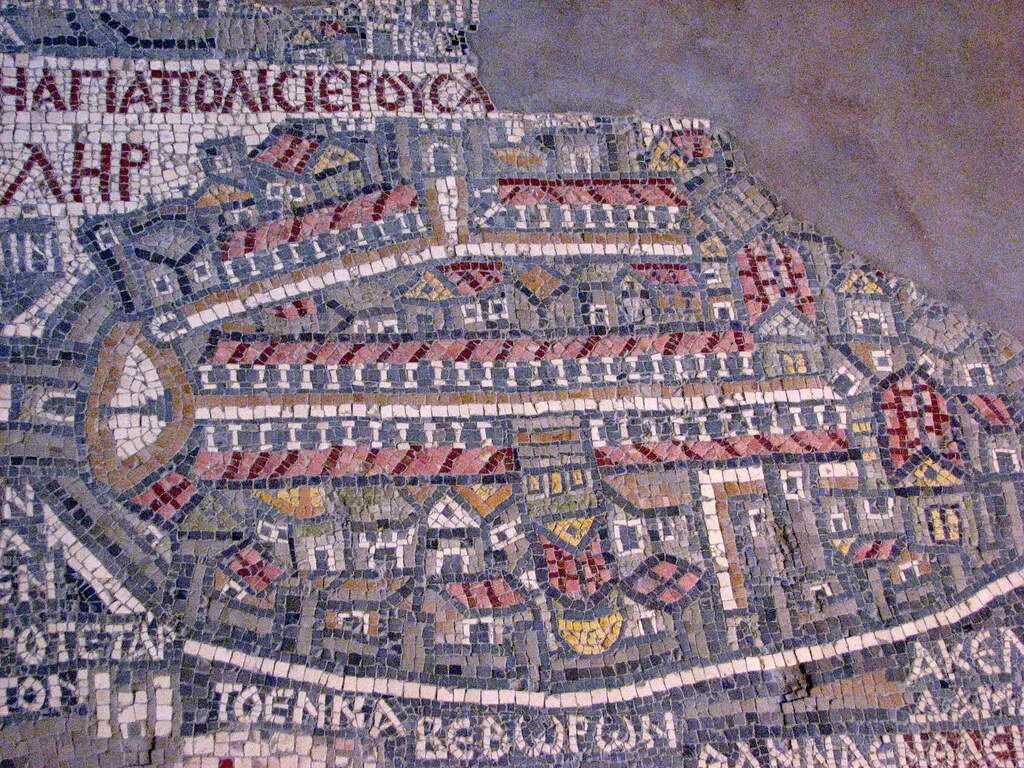
Our Resource: A framework for thinking these new synodal processes and habits. Drawing on the Council of Jerusalem. It can be applied to any group making decisions or discerning the future.

Bishop Nicholas Hudson Synodality Interview
Our Resource: Bishop Nicholas Hudson and Avril Baigent discuss life at the Synod in Rome, and how we can bring synodality into our parishes at home.
Bishop Nicholas Hudson, auxiliary bishop of Westminster and Synod delegate, was interviewed at our event 'From Rome to Home' by Avril Baigent, the Co-Director of the School for Synodality and a Synod facilitator. They discussed their shared experiences of the Synod in Rome, and what synodality might mean for our Catholic communities at home.
Watch the interview in full below:

Explainer video - What is Synodality?
Our Resource: What is Synodality, exactly? Watch and share the School for Synodality’s video exploring the core components of the synodal way.
The School for Synodality has created this short animation video exploring the synodal way, explaining it not as a one-off listening exercise but rather as an invitation towards an ongoing call to conversion, reshaping how we attend to all things, guided by the working of the Holy Spirit.
While the ancient practice of synodality can be found throughout Church history, where leaders of the Church gathered in a way to listen and discern together, what is different here is this invitation into the practice of synodality is for all the people of God.
We are all invited to integrate this ancient practice at all levels of the Church - including local, diocesan, national and global - changing how we gather, how we listen, how we include, how we plan, how we discern, and how we move forward together as a people of God.
When we build on this style of encounter, when we include different voices and open the space to all, to discern and dream together, we can we strengthen the bonds of love and enrich all aspects of Church life.

Conversation in the Spirit Resource Cards
Our Resource: We have created these helpful cards that can be used to facilitate Conversations in the Spirit within your own communities. We have a professional printer version and a standard home printing version.

Practising Synodality Webinar Series
Our Resource: On-demand versions of our Practising Synodality webinar series, in which we heard from several important voices on the topic of synodality.

Leading Prayer in Meetings
Our Resource: Step by step directions for meetings that draw on the rich tradition of Lectio Divina. This process can help us enrich decision making meetings to be both more effective, and become encounters that help us grow as living communities of faith.